How to Handle Cultural Differences in Love Marriages
2026-01-31Love marriages are built on emotional connection, mutual respect, and personal choice. However, when...
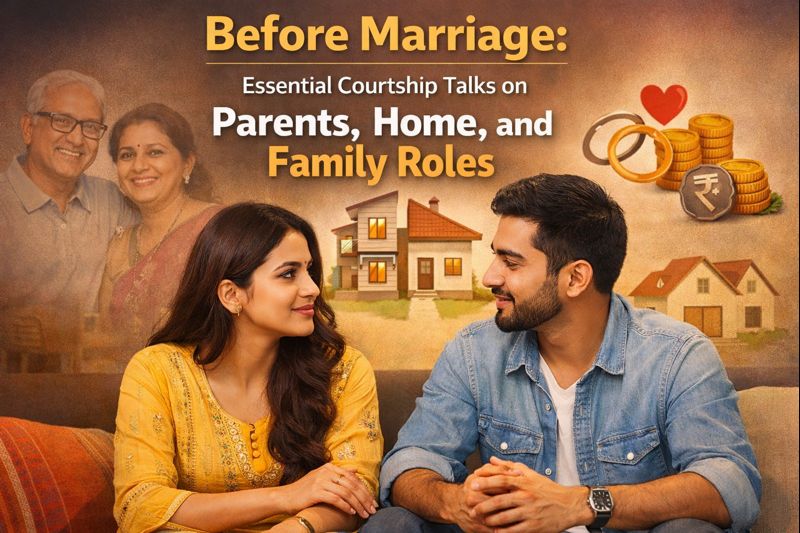
In India, marriage is never just about two individuals—it is a union of families, expectations, responsibilities, and lifestyles. While modern matchmaking focuses heavily on compatibility, shared interests, and emotional connection, many marriages struggle later due to unspoken assumptions about family life.
Courtship before marriage is the most important phase to discuss these realities. Topics like parents’ involvement, living arrangements, financial responsibilities, and family roles may feel uncomfortable, but avoiding them often leads to conflict after marriage.
This guide explains why courtship must go beyond compatibility and outlines the most important pre-marriage discussions Indian couples should have for a stable and happy married life.
Compatibility usually covers:
Emotional understanding
Lifestyle and habits
Career goals
Communication style
However, Indian marriages also involve:
Strong parental influence
Joint family expectations
Cultural traditions
Financial and emotional responsibilities
Many couples say later, “We were compatible, but we never discussed family expectations.”
This gap is one of the biggest reasons for marital stress in India.
That’s why courtship before marriage should focus not just on love, but on life after marriage.
Parents are central to Indian family life, and ignoring this reality can create long-term friction.
How involved will parents be in daily decisions?
Will parents live with the couple now or in the future?
What are the expectations for caring for aging parents?
How will festivals, rituals, and family obligations be managed?
A couple agrees on everything, but after marriage, one partner expects daily parental involvement while the other expects independence. The mismatch leads to frustration—not because of incompatibility, but lack of discussion.
Living arrangements are one of the most searched and sensitive pre-marriage topics in India.
Joint family with parents
Nuclear family in the same city
Separate city due to job
Temporary joint living
Is joint family living permanent or temporary?
How will privacy and independence be handled?
What happens if a job relocation is required?
Are both partners emotionally prepared for shared family spaces?
Many conflicts in Indian marriages stem from assumptions, not disagreements. Courtship is the right time to replace assumptions with clarity.
Every household has its own rhythm. What feels normal in one family may feel overwhelming in another.
Household responsibilities
Role of daughter-in-law or son-in-law
Involvement in extended family matters
Social obligations and gatherings
Many women today worry about:
Loss of personal space
Career continuity after marriage
Emotional expectations from in-laws
Addressing these concerns openly during courtship builds trust and emotional safety.
Money discussions are often avoided, but they are critical for long-term harmony.
Supporting parents or siblings financially
Shared vs individual expenses
Savings, investments, and lifestyle priorities
Emergency responsibilities
Financial misunderstandings are one of the top causes of marital stress. Transparent courtship discussions help couples align expectations early.
In Indian marriages, decisions are often influenced by both partners and families.
Career changes
Major financial decisions
Relocation and housing
Family obligations
Understanding each other’s decision-making style avoids power struggles later.
Even within the same religion or community, traditions vary widely.
Religious practices at home
Wedding rituals and customs
Festival celebrations
Food habits and lifestyle rules
Respecting traditions does not mean sacrificing individuality—it means finding balance.
Not every difference is a deal-breaker. Courtship helps identify what truly matters.
Complete mismatch on living arrangements
Conflicting expectations about parental care
Career restrictions after marriage
Festival styles
Household routines
Social habits
This clarity helps couples make confident marriage decisions.
Modern matchmaking should encourage clarity, not confusion. Platforms like DigiShaadi help individuals and families:
Find serious, marriage-focused matches
Discuss expectations early
Involve families transparently
Match based on values, not just profiles
When expectations are aligned early, marriages become stronger and more peaceful.
Choose calm, private moments
Avoid blaming language
Listen actively
Be honest but respectful
Give each other time to reflect
Courtship is not about convincing—it’s about understanding.
Compatibility may start a relationship, but clarity sustains a marriage.
By discussing parents, living arrangements, financial responsibilities, and family roles during courtship, couples avoid future surprises and emotional strain.
A thoughtful courtship leads to:
Better family harmony
Fewer conflicts
Stronger emotional bonds
Before saying “yes,” make sure the right conversations have already happened.

Love marriages are built on emotional connection, mutual respect, and personal choice. However, when...

Finding a life partner as an NRI is very different from local matchmaking in India. Along with emoti...
In the Indian matchmaking system, a marriage biodata is much more than a formal introduction. It is...

Introduction: Marriage Is a Decision, Not a Discovery Choosing a life partner is one of the most si...
Introduction: Successful NRI Marriages Are Built on Clarity, Not Chance Non-Resident Indian (NRI) m...

Introduction: NRI Marriage Is Not Just Long-Distance Love Finding an NRI life partner is not merely...