How to Handle Cultural Differences in Love Marriages
2026-01-31Love marriages are built on emotional connection, mutual respect, and personal choice. However, when...

Choosing a life partner is one of the most significant decisions a person makes. In Indian matrimony—whether arranged, semi-arranged, or self-chosen—marriage is not merely about attraction or family approval. It is about long-term alignment, emotional stability, and shared life direction.
Two factors play a decisive role in this process: courtship and compatibility. When either is ignored or rushed, marriages often struggle after the initial phase. When both are given due importance, relationships gain clarity, confidence, and resilience.
This article explains why courtship and compatibility are essential in choosing the right life partner—especially in the Indian context.
Courtship refers to the phase where two individuals get to know each other with the intention of marriage. In India, courtship has evolved significantly.
Limited conversations
Heavy family control
Decisions based largely on biodata and background
Structured conversations
Emotional and practical discussions
Balance between individual choice and family involvement
Courtship is no longer a formality—it is a decision-making phase.
Courtship allows individuals to move beyond surface-level impressions and understand each other realistically.
During healthy courtship, couples learn:
How the other person communicates under stress
Whether values align in real situations
How decisions are made—individually and jointly
Attitudes towards family, career, finances, and responsibilities
Without adequate courtship, marriage becomes a leap of faith rather than an informed choice.
Compatibility is often misunderstood as having similar likes or personalities. In reality, it is about how differences are handled, not whether differences exist.
True compatibility includes:
Emotional maturity
Conflict-resolution style
Lifestyle expectations
Cultural and family alignment
Long-term goals
Two people do not need to be identical—but they must be adaptable and respectful of each other’s realities.
Emotional compatibility determines how safe and understood partners feel with each other.
Key indicators include:
Ability to express concerns without fear
Mutual empathy during difficult phases
Emotional availability, not just presence
Respect for personal boundaries
Marriages fail not because couples disagree, but because they cannot emotionally navigate disagreements together.
Values shape everyday decisions—often unconsciously.
Important areas of alignment include:
Views on marriage roles and responsibilities
Career ambition and work-life balance
Financial habits and priorities
Parenting expectations
Religious and cultural practices
Courtship provides the space to identify whether differences are manageable or fundamentally conflicting.
One of the biggest advantages of courtship is early awareness.
Healthy courtship helps identify:
Communication gaps
Avoidance of serious topics
Inconsistent behaviour
Unrealistic expectations
Resistance to accountability
Ignoring red flags during courtship often leads to amplified problems after marriage.
In Indian marriages, compatibility is not limited to two individuals—it extends to families.
Courtship allows:
Observation of family dynamics
Understanding parental expectations
Clarifying boundaries and involvement
Assessing cultural adaptability
When family compatibility is addressed early, post-marriage pressure reduces significantly.
Contrary to common belief, arranged marriages require more structured courtship, not less.
In arranged setups:
Initial attraction may be limited
Trust needs time to build
Assumptions are more common
Intentional courtship ensures that compatibility is evaluated thoughtfully rather than assumed.
Today’s matrimony platforms enable meaningful courtship by:
Allowing extended conversations
Facilitating family involvement when required
Providing time and space for clarity
Encouraging informed decision-making
Platforms like DigiShaadi emphasise compatibility and intent, ensuring that courtship leads to confident marital decisions—not rushed commitments.
Many couples underestimate courtship and compatibility due to:
Age or family pressure
Emotional attachment formed too quickly
Over-reliance on biodata or credentials
Fear of “losing a good match”
Marriage decisions made in haste often demand patience later.
There is no fixed timeline, but sufficient courtship should allow:
Multiple meaningful conversations
Discussion of uncomfortable topics
Observation of consistency in behaviour
Alignment on major life decisions
Quality of interaction matters more than duration.
Courtship and compatibility are not optional stages—they are the foundation of a stable marriage. They allow individuals to choose with awareness, not assumptions.
In Indian matrimony, where marriage is a lifelong commitment involving families, culture, and responsibilities, informed decision-making becomes even more critical.
A successful marriage is not found—it is chosen carefully, through honest courtship and genuine compatibility.

Love marriages are built on emotional connection, mutual respect, and personal choice. However, when...

Finding a life partner as an NRI is very different from local matchmaking in India. Along with emoti...
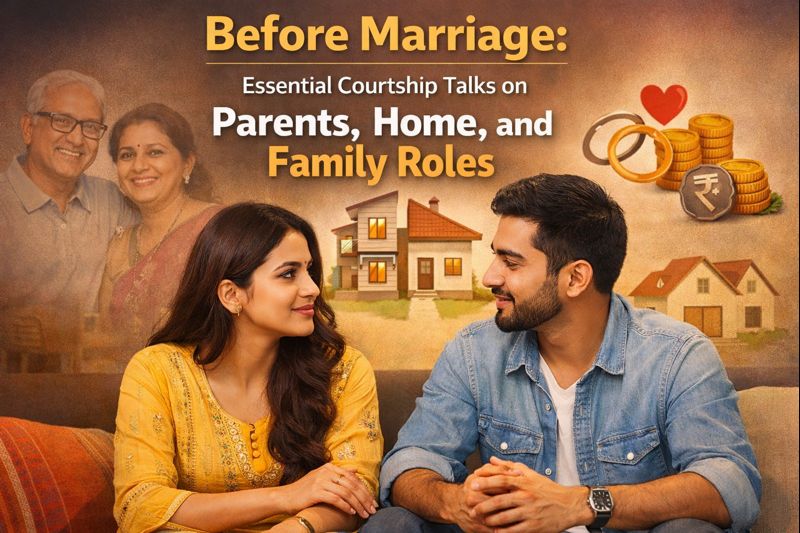
In India, marriage is never just about two individuals—it is a union of families, expectations, resp...
In the Indian matchmaking system, a marriage biodata is much more than a formal introduction. It is...
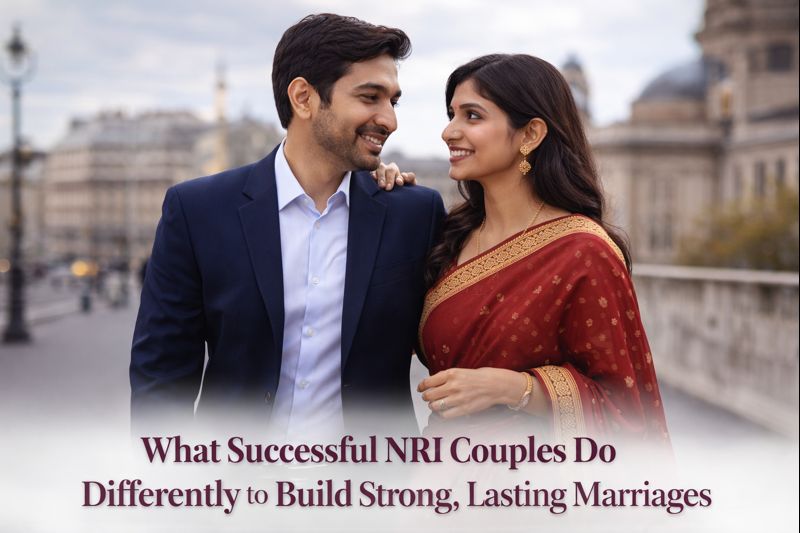
Introduction: Successful NRI Marriages Are Built on Clarity, Not Chance Non-Resident Indian (NRI) m...

Introduction: NRI Marriage Is Not Just Long-Distance Love Finding an NRI life partner is not merely...