How to Handle Cultural Differences in Love Marriages
2026-01-31Love marriages are built on emotional connection, mutual respect, and personal choice. However, when...
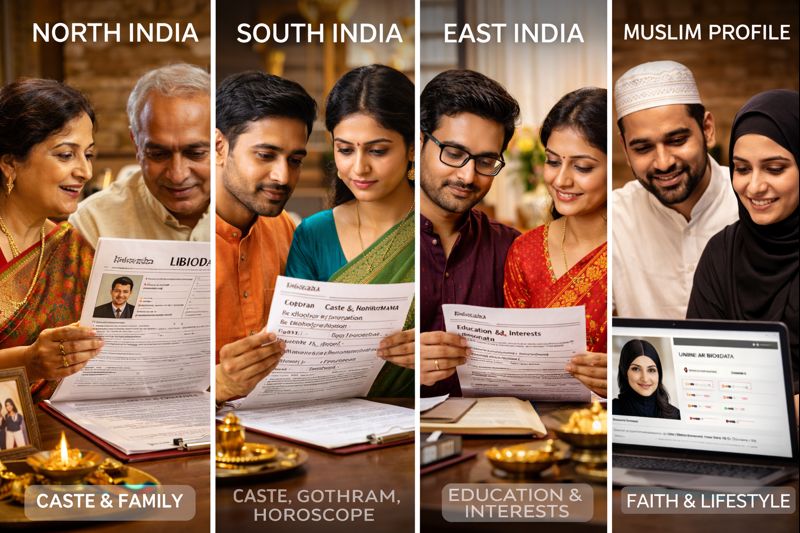
In India, a marriage biodata is never just a document—it is a cultural introduction. It quietly communicates where a person comes from, what values their family holds, and how well they may fit into another household. While formats may look similar at first glance, marriage biodata across India varies deeply based on regional traditions, community norms, and family expectations.
Understanding these cultural differences is no longer optional—especially in today’s mix of traditional families and modern matchmaking platforms.
Indian marriages are not individual contracts; they are family and cultural unions. That is why biodata becomes a filter for:
Cultural continuity
Social compatibility
Lifestyle alignment
Long-term family harmony
What one community proudly highlights, another may consider unnecessary—or even inappropriate.
| Region | Cultural Focus in Biodata | Tone |
|---|---|---|
| North India | Family status, profession, assets | Confident & formal |
| South India | Lineage, education, traditions | Structured & factual |
| East India | Values, education, individuality | Soft & thoughtful |
| West India | Practicality, stability | Clear & concise |
| Muslim Communities | Faith & upbringing | Respectful & values-led |
| Christian Communities | Education & modern outlook | Balanced |
This table alone explains why one-size-fits-all biodata formats fail.
In North Indian communities (Punjab, Haryana, Delhi, UP, Rajasthan), marriage biodata often reflects collective family identity.
Father’s profession and social position
Family business or property
Educational background
Caste and gotra
A North Indian biodata may state:
“Belongs to a well-respected business family settled in Delhi NCR.”
This line instantly signals status, stability, and social alignment—something families read between the lines.
Punjabi biodatas go a step further by reflecting:
Financial stability
Outgoing personality
Balanced modern–traditional mindset
Words like “progressive family with strong cultural roots” are common and culturally understood.
In Tamil, Telugu, Kannada, and Malayalam communities, biodata is treated almost like a formal record.
Caste and sub-caste
Gothram or ancestral lineage
Horoscope (often mandatory)
Education and profession
A Tamil biodata might include:
“Iyer, Vadama sub-sect, belonging to Bharadwaj Gothram.”
For outsiders this may seem excessive—but culturally, it prevents future mismatch.
Tamil biodatas rarely exaggerate. They aim for:
Clear expectations
Lifestyle compatibility
Ritual alignment
The belief is simple: clarity today prevents conflict tomorrow.
Bengali, Odia, and Assamese communities value intellectual and emotional depth.
Academic background
Cultural interests (music, reading, arts)
Balanced individuality
A Bengali biodata may mention:
“Enjoys Rabindra Sangeet and values meaningful conversations.”
This reflects a culture that prioritizes mental compatibility.
Gujarati and Marathi biodatas focus on clarity and feasibility.
Business or professional growth
Financial responsibility
Simple, value-driven family life
Overstatement is avoided; honesty is preferred.
Across regions, Muslim biodatas prioritize:
Religious practices
Education and upbringing
Lifestyle expectations
While language differs regionally, faith-based compatibility remains central.
Indian Christian biodatas usually highlight:
Education and profession
Church involvement
Openness to partnership-based marriage
They often balance tradition, faith, and modern expectations gracefully.
Cultural continuity
Family reputation
Social compatibility
Personal values
Lifestyle alignment
Emotional compatibility
A successful biodata quietly satisfies both—this is where most people fail.
Modern platforms like Digi Shaadi allow:
Structured yet flexible biodata formats
Cultural filters without rigidity
Better clarity between families
However, culture hasn’t disappeared—it has just learned to adapt digitally.
Copy-paste biodata templates
Over-modern language for traditional families
Missing cultural markers
Misrepresentation of values
Such biodatas often get rejected silently.
A 10/10 Indian marriage biodata should:
Respect cultural roots
Communicate personal identity
Maintain honesty and clarity
Avoid exaggeration
Culture should guide—not restrict—the presentation.
Across India, marriage biodata changes in format, tone, and focus—but culture silently shapes every word.
The strongest biodata is not the most impressive one.
It is the one that feels culturally familiar, emotionally honest, and future-ready.
That is what truly leads to meaningful matches in Indian matrimony.
Love marriages are built on emotional connection, mutual respect, and personal choice. However, when...
Finding a life partner as an NRI is very different from local matchmaking in India. Along with emoti...
In India, marriage is never just about two individuals—it is a union of families, expectations, resp...
In the Indian matchmaking system, a marriage biodata is much more than a formal introduction. It is...

Introduction: Marriage Is a Decision, Not a Discovery Choosing a life partner is one of the most si...
Introduction: Successful NRI Marriages Are Built on Clarity, Not Chance Non-Resident Indian (NRI) m...