How to Handle Cultural Differences in Love Marriages
2026-01-31Love marriages are built on emotional connection, mutual respect, and personal choice. However, when...
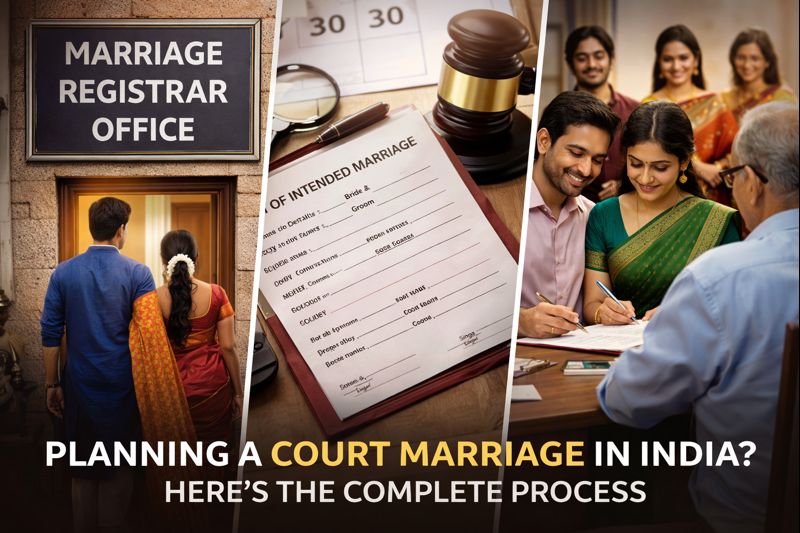
Court marriage in India is no longer just an alternative—it has become a preferred legal route for couples who value clarity, consent, and simplicity. Whether you’re planning an inter-religion marriage, an inter-caste union, or simply want a legally secure marriage without elaborate rituals, court marriage provides a lawful and dignified option.
This guide explains the complete court marriage process in India, step by step, with legal clarity, document checklists, state realities, and FAQs, so you can proceed confidently.
Court marriage is a civil marriage solemnized before a Marriage Registrar under Indian law, without religious rituals.
It is primarily governed by:
The Special Marriage Act, 1954
(Sections 5–14)
This Act applies to:
Same-religion couples
Inter-religion couples
Inter-caste marriages
Under Indian law:
Groom must be 21 years or above
Bride must be 18 years or above
Both parties must give free and valid consent
Neither partner should have a living spouse
Both should be mentally fit to consent
Parties should not fall under prohibited relationships
(unless permitted by custom)
You must apply at the Marriage Registrar’s office of:
The district where either partner has lived for at least 30 days
Proof of residence is mandatory (rent agreement, utility bill, etc.)
A written notice is submitted under Section 5 of the Special Marriage Act
Contains personal details of both partners
Signed by both parties
The Registrar then:
Enters the notice in the Marriage Notice Book
Displays it publicly (Section 6)
A 30-day notice period is compulsory
During this time, objections can be raised under Section 7
Objections are rare
Only valid on legal grounds (age, marital status, consent)
Family disagreement alone is not a valid legal objection
Age Proof (any one):
Birth certificate
10th marksheet
Passport
Address Proof (any one):
Aadhaar Card
Voter ID
Passport
Rent agreement + utility bill
Other Documents:
Passport-size photographs (usually 4 each)
Identity proof
Affidavit (marital status, nationality, consent)
If previously married:
Divorce decree / death certificate of spouse
Three witnesses are required
Witnesses must be:
Adults
Carry valid ID proof
Can be parents, relatives, or friends
Both partners and witnesses appear before Registrar
Declaration is signed
Marriage is solemnized
Marriage Certificate issued
This certificate is legally valid across India and internationally.
| Stage | Approx Time |
|---|---|
| Notice submission | Day 1 |
| Waiting period | 30 days |
| Marriage & certificate | Day 31–35 |
Total time: ~30–35 days
Government fees vary slightly:
Typically ₹100–₹500
Delhi, Maharashtra, Punjab: similar range
Additional cost only if:
Lawyer hired
Extra affidavits required
Expensive “packages” are not mandatory.
| Special Marriage Act | Hindu Marriage Act |
|---|---|
| Religion-neutral | Only Hindus |
| Mandatory 30-day notice | No notice |
| Civil ceremony | Religious rituals |
| Ideal for inter-faith | Same-religion only |
Lawyer is NOT mandatory if:
Documents are clear
No objections expected
Both parties available
Lawyer may help if:
Inter-religion complications
Address proof issues
Family pressure or objections
Court marriage is secret
It is public, legal, and official
Parents cannot attend
Parents can be witnesses
Court marriage has no respect
It is legally superior to rituals
Q1. Can court marriage be done in one day?
No. The 30-day notice period is mandatory.
Q2. Is court marriage valid abroad?
Yes. Marriage certificate is internationally accepted.
Q3. Can parents stop a court marriage?
No, if both partners are adults and consenting.
Q4. Can we have a religious ceremony after court marriage?
Yes. Court marriage does not restrict celebrations.
Many couples:
Meet via matrimony platforms
Choose court marriage for legal security
Later plan family ceremonies or receptions
Legal marriage + social acceptance often go hand in hand.
Court marriage in India is not about avoiding tradition—it is about starting marriage with legal certainty, equality, and clarity.
When done correctly, it is:
Lawful
Respectful
Stress-free
Marriage begins with commitment.
Court marriage simply ensures that commitment is legally protected.

Love marriages are built on emotional connection, mutual respect, and personal choice. However, when...
Finding a life partner as an NRI is very different from local matchmaking in India. Along with emoti...
In India, marriage is never just about two individuals—it is a union of families, expectations, resp...
In the Indian matchmaking system, a marriage biodata is much more than a formal introduction. It is...
Introduction: Marriage Is a Decision, Not a Discovery Choosing a life partner is one of the most si...
Introduction: Successful NRI Marriages Are Built on Clarity, Not Chance Non-Resident Indian (NRI) m...