How to Handle Cultural Differences in Love Marriages
2026-01-31Love marriages are built on emotional connection, mutual respect, and personal choice. However, when...
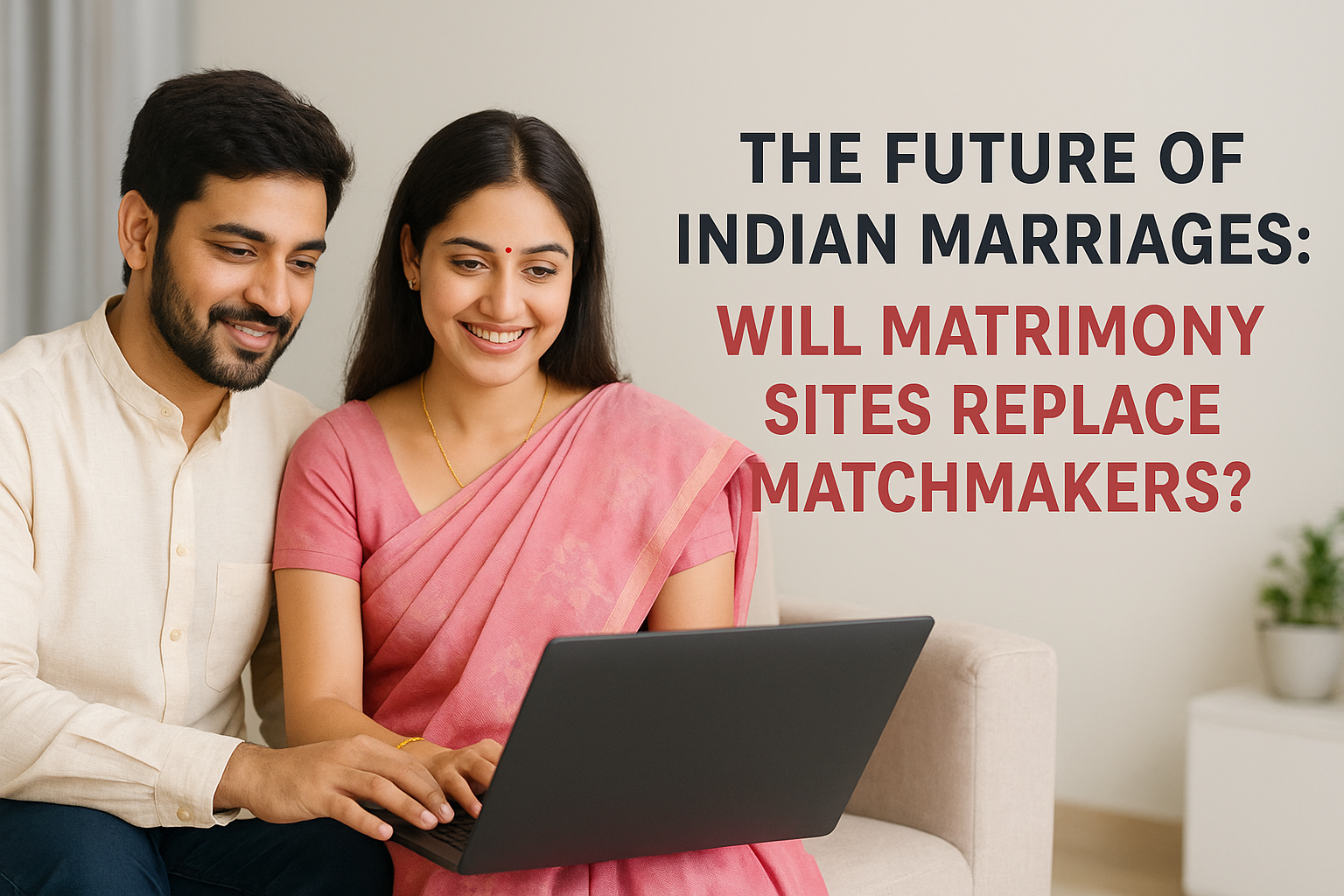
Marriage in India has never been just about two individuals—it has always been a union of families, traditions, and community values. For centuries, the responsibility of finding the “right match” rested with community elders, trusted relatives, and local matchmakers. They brought in not only familiarity with the family’s background but also a sense of accountability.
Fast-forward to today, and the landscape looks remarkably different. Matrimony websites and apps are rewriting the way Indians search for life partners. With millions of profiles available at one’s fingertips, advanced filters, and verified safety tools, technology is slowly but surely stepping into a role once dominated by human intermediaries.
But does this mean that online matrimony platforms will completely replace traditional matchmakers? Or is the future going to be a hybrid of both worlds? Let’s dive deep into this evolving dynamic.
For decades, marriages in India have been arranged through:
Community networks: Families relied on relatives, temple gatherings, and caste associations.
Professional matchmakers: Middlemen who kept a “mental database” of eligible bachelors and brides.
Word of mouth: Reputation and family background were discussed in closed circles.
The strength of this system lay in trust. Families believed that the person recommending a match already knew enough about the prospective family’s values, social standing, and traditions.
However, this system also had limitations:
Restricted to local or community-based connections.
Lack of transparency in the process.
Women often had limited choice or say in the matter.
The process was slow, manual, and prone to biases.
With the internet boom in the late 1990s and early 2000s, matrimonial websites emerged as a revolution. Today, platforms like DigiShaadi provide:
Nationwide and global reach: NRIs and Indians across states can find matches seamlessly.
Advanced filtering: Users can search by profession, education, religion, caste, location, or even values.
Verified profiles: Reduces the risk of fraud and misrepresentation.
Time-saving: Families can shortlist and interact without endless middlemen calls.
The biggest advantage? Empowerment of individuals. Unlike traditional systems where families led the conversation, online platforms allow individuals to take charge of their own search while still involving parents when needed.
This is where the debate gets interesting. While online platforms are booming, matchmakers still hold relevance in certain contexts:
Smaller towns and rural India: Families still prefer personal introductions.
Culturally conservative communities: Where caste and community boundaries are strictly observed.
Families seeking “elite” or niche matches: High-status or ultra-traditional families sometimes trust long-standing matchmakers more than technology.
But the younger, urban generation leans heavily toward digital solutions, and parents are gradually warming up to the convenience they bring.
It’s unlikely that matrimony sites will “kill” traditional matchmakers altogether. Instead, the future points toward a hybrid model:
Trust of traditional matchmaking + Efficiency of technology
Families may still consult elders, but final matches will likely be vetted online.
Matchmakers themselves are shifting online, using matrimony portals to expand their networks.
Younger Indians are involving parents in their online search, keeping traditions alive while enjoying tech convenience.
Let’s consider some undeniable factors driving the future of Indian marriages online:
Globalisation of Indian marriages – NRIs seeking partners across borders need digital matchmaking.
Changing gender roles – Educated women want a say in choosing their life partners.
Data and compatibility-based matching – Beyond caste and horoscope, platforms are focusing on values, career goals, and lifestyle alignment.
Safety and verification tools – With AI, fraud detection, and background checks, platforms can offer more security than word-of-mouth matchmakers.
Speed and scale – While a matchmaker can manage a few dozen clients, a platform manages millions simultaneously.
Emotional trust: Many parents feel reassured by a human intermediary.
Community respect: Certain caste-based communities still prefer traditional gatekeepers.
Offline reassurance: For families uncomfortable with “apps”, having a mediator feels safer.
So while matrimony sites dominate metros, rural areas and conservative groups may continue with offline matchmaking for years.
Industry reports show India’s online matrimony industry is worth ₹6,500+ crores and growing rapidly.
Surveys indicate that over 60% of urban marriages now originate online.
Matchmakers themselves are increasingly adopting hybrid roles—offering personal services but relying on digital databases.
Instead of imagining a future where matrimony sites “replace” matchmakers, it’s better to envision a future where:
Platforms act as matchmaking engines.
Families and matchmakers provide emotional validation.
Individuals maintain agency and choice in decision-making.
The future of Indian marriages will likely be pluralistic, giving space to both tradition and technology.
Marriage in India has always been dynamic, adapting to social, cultural, and technological shifts. Just as arranged marriages transformed into love-cum-arranged unions, matchmaking too is evolving.
Matrimony sites won’t completely erase traditional matchmakers, but they will become the dominant force driving matches in the coming decades—especially among educated, urban, and global Indians.
The question isn’t whether online matrimony will replace traditional matchmakers. The real question is: how will the two coexist to ensure Indian marriages remain both rooted in tradition and ready for the future?
Love marriages are built on emotional connection, mutual respect, and personal choice. However, when...
Finding a life partner as an NRI is very different from local matchmaking in India. Along with emoti...
In India, marriage is never just about two individuals—it is a union of families, expectations, resp...
In the Indian matchmaking system, a marriage biodata is much more than a formal introduction. It is...
Introduction: Marriage Is a Decision, Not a Discovery Choosing a life partner is one of the most si...
Introduction: Successful NRI Marriages Are Built on Clarity, Not Chance Non-Resident Indian (NRI) m...